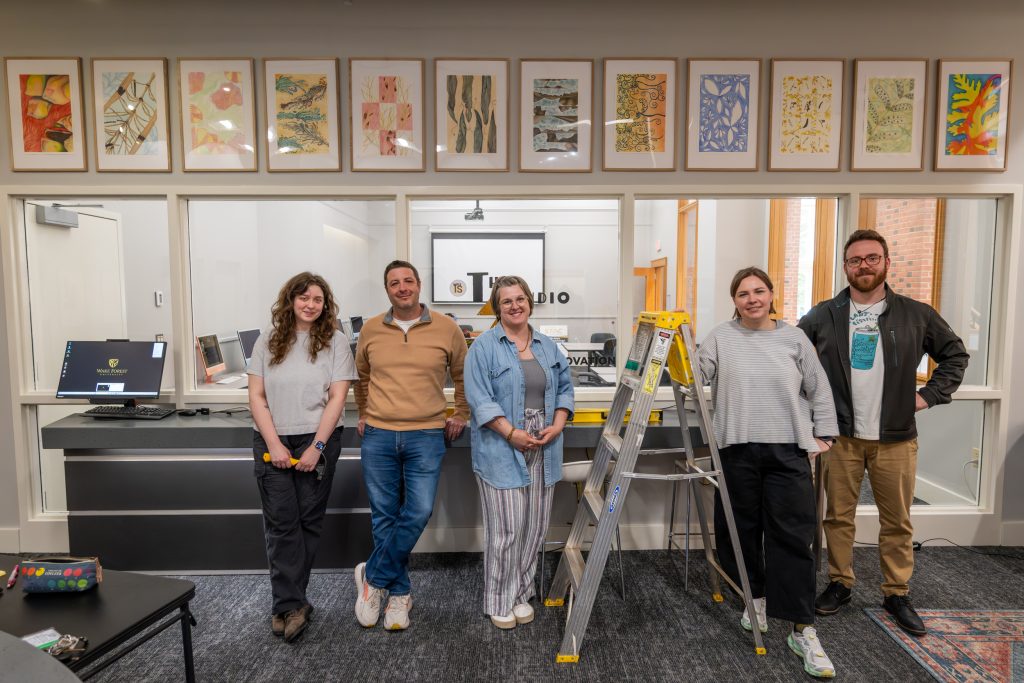
Botanical Bridges
How observation and interdisciplinary collaboration shaped a student exhibition at The Bridge.
On a quiet floor of Winston Hall, behind doors that carefully regulate temperature and light, the Wake Forest University Herbarium preserves its collection of plants with deliberate care.
Pressed leaves and stems, some gathered more than a century ago and others carried from distant landscapes, rest there as records of attention once paid. It was in this environment that a group of students, guided by Assistant Teaching Professor of Drawing Lydia Smith and Assistant Professor of Botany Christopher P. Krieg, began a project that asked them to reconsider not only how they draw, but how they see.
The exhibition, Botanical Bridges: Observation and Invention, grew out of a chance meeting between Smith and Krieg during a new faculty orientation. What began as a conversation about research interests soon shifted toward a shared curiosity about observation and about looking as a practice that bridges disciplines. Months later, the work that emerged from those exchanges now hangs at The Bridge in Z. Smith Reynolds Library, a space whose name has become unexpectedly literal through the project.
“I think it all comes down to being in community,” Smith said. “Connecting with who’s around you and being open to new opportunities.”
Students participating in the project were enrolled in ART 218, Life Drawing, during the Spring 2026 semester. From the outset, Smith said, the collaboration centered on attention.
“When we were thinking about an interdisciplinary connection between art and biology, the theme of observation and close looking came up,” she said.
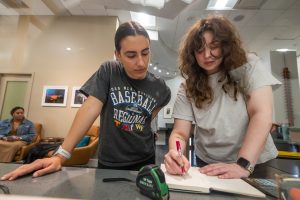
Each student was assigned a specimen selected from the Wake Forest University Herbarium and asked to work through two distinct processes. The first emphasized precision. Students produced highly realistic drawings grounded in sustained observation and research, often using magnifying glasses to examine fine details such as vein structures, joints, and surface textures. Looking closely was not treated as preparation for the work. It was the work.
The second drawing allowed for a shift in method. Students were encouraged to translate what they had learned through observation into something imaginative or abstract.
“There are two iterations of the project,” Smith said. “One is a very one-to-one observational study of a specimen, and the other takes that close looking and pulls it into something imaginative and abstracted.”
The specimens were curated by Krieg, who describes the herbarium as a museum in its own right.
“A herbarium is a museum for plants,” Krieg said. “It’s a curated collection of preserved specimens that permanently documents biological information.”
Some of the plants students encountered were more than 100 years old. Others originated in places such as Japan or Belize. Krieg intentionally selected species that resist the familiar mental image many people associate with plants.
“I wanted students to look closely at things that did not match the first image that pops into your brain when you think of a plant,” he said. “Most people think of flowers.”
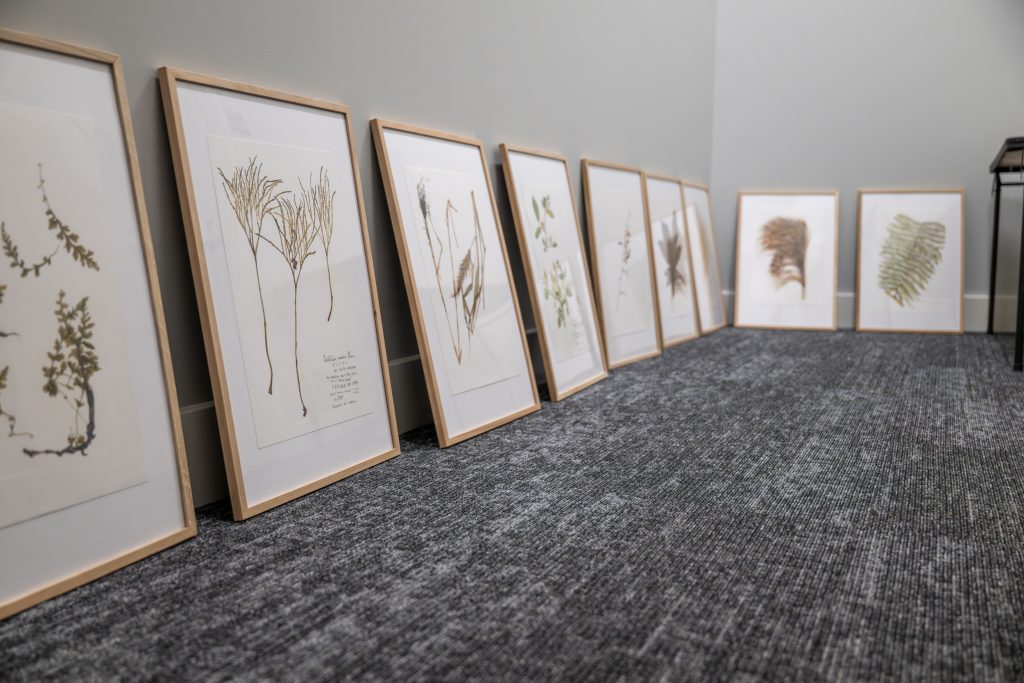
Instead, the selection included ancient and flower-free lineages like ferns and pine trees, plants whose complexity reveals itself only through patience. Krieg has described this encounter as one shaped by the surprise of subtlety.
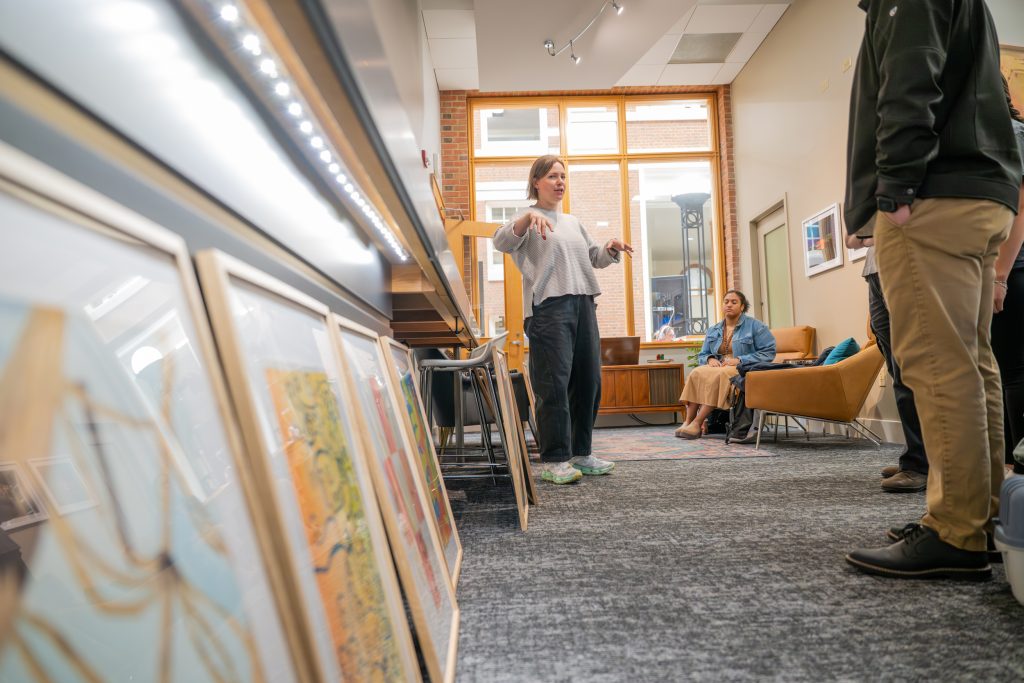
For Smith, this scientific framework offered a thoughtful counterpoint to her own curatorial intuition. The exhibition’s layout reflected a bifurcated approach: Krieg arranged the observational drawings according to biology and time, while Smith envisioned the arrangement of the abstract and inventive works through more fluid principles of balance, rhythm, and emotional resonance, attending to how the works might echo or resist one another upon the wall.
“When we talk about observation, we are really asking how we gain information and how we create a system for knowledge,” Smith said. “I was thinking about how two drawings might work together or balance each other out, and how that relationship shapes the experience.”
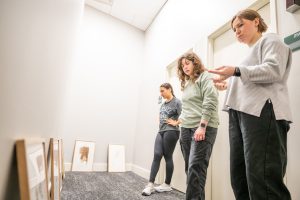
That question of systems and access made The Bridge a fitting site for the exhibition. Located at the heart of Z. Smith Reynolds Library, The Bridge serves as the primary point of contact for Information Systems support on the Reynolda Campus. Each day, students arrive with questions about technology, access, and problem-solving, often expecting efficiency and immediacy. Botanical Bridges introduces a different mode of engagement into that environment, one grounded in patience and sustained attention.
For junior Gianna Palacios-Diegel, the assignment became an extended conversation with a single plant. Her specimen, Ephedra nevadensis, is a desert species that has existed for more than 100 million years. Its sparse, broom-like structure became the focus of her initial drawing.
Her second drawing took a different approach. Using a geometric grid and bold color, she reimagined the plant’s structure, emphasizing contrast rather than restraint.
“In the desert it’s very plain, so I wanted to contrast that with the colors so it would stand out more,” she said. “The plant itself is very simple, but the colors made it feel more alive.”
After working on the project since January, seeing the drawings installed marked a moment of clarity. For senior Mia Burke, a Business & Enterprise Management and Studio Art double major, the exhibition represented a first encounter with botanical science as a creative partner.
“This exhibition is a strong example of Wake Forest’s interdisciplinary nature,” Burke said. “As someone with little exposure to the biology department, I enjoyed learning about the Herbarium and the specimens we were drawing. Working with those materials made the process feel both creative and scientific—a crossover I hadn’t experienced before.”
Burke noted that the project expanded her understanding of what life drawing can encompass.
“Life drawing is often associated with the human figure,” she said, “but this assignment reminded me that there are many other forms of life around us. Focusing on plants highlighted how much bigger life is than just the human, and how often plants, animals, and other living beings are diminished or overlooked.”
Developing both observational and abstract drawings, she added, allowed students to move beyond human-centered seeing and reimagine the specimens through accumulated knowledge rather than instinct alone.
“Leaning into the information we learned about the plants gave them a new life,” Burke said.
For Margrethe Jensen, a senior majoring in English with minors in Studio Art and Marketing Communication, the project emphasized precision before invention.
“We spent several classes with Professor Krieg learning the basics of plant structures, which really helped us understand what we were looking at,” Jensen said. “Our first drawings focused on copying the likeness of the specimen using pencil and watercolor, which required intense close-looking because every plant was intricate and completely different.”
Only after that period of careful observation were students encouraged to loosen their approach.
“Once we moved into abstraction, it was fascinating to see how everyone’s personal style came through,” she said. “You could trace elements of the observational drawings into the abstract ones and see which details had stayed with each person.”
Freshman Courtney Frank, an intended biology major, described the project as an opportunity to slow down and reconsider everyday perception.
“We spend so much time going through the motions that we rarely stop to truly look at the world around us,” Frank said. “This project forced us to pause, take a breath, and notice all of the intricacies nature has to offer.”
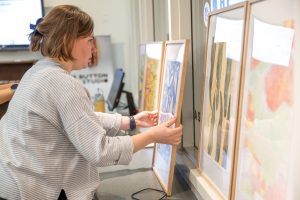
The exhibition’s placement at The Bridge was shaped through collaboration with Amy Triana, Director of Client Services for Information Systems. She sought to translate the project’s interdisciplinary aims into a lived experience within a space defined by service. Rather than viewing art as a distraction from daily operations, the collaboration treated curiosity as a shared value between creative inquiry and technical support.
Working alongside faculty and University Collections, Triana helped envision how the exhibition could exist within the natural rhythms of The Bridge. The drawings remain visible during routine consultations, troubleshooting sessions, and moments of waiting. In that context, the artwork invites pause without insisting upon it, offering another way to think about how knowledge is accessed, supported, and shared.
The exhibition reached the space through campus partnerships that included Erin Kye of University Collections and an invitation for Smith to propose a student exhibition that would engage a broad audience while respecting the functional needs of the environment.
Smith described the synergy that allowed the project to move from the classroom to the library.
“Erin Kye, the preparator for University Collections, introduced me to Amy Triana, who then invited me to propose an exhibition of student work and make The Bridge an even more welcoming and inviting space. Students from all disciplines visit The Bridge for support from information systems. It is a place for potential collaboration and connection! Therefore, I was excited to showcase an interdisciplinary project from my Life Drawing course, in collaboration with Wake Botany and the Department of Biology, as a celebration of interdepartmental connections on campus.”
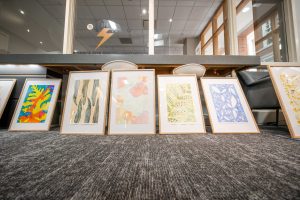
A recent renovation had already softened The Bridge through updated lighting, new seating, and a vintage record player that introduces a gentle sonic presence into daily operations. With support from Wake the Arts, which funded the framing and presentation of the work, the drawings are displayed with the same care that shaped their making.
Botanical Bridges brings together twenty‑four watercolor and colored pencil drawings, each created and personally framed by students in Lydia Smith’s Spring 2026 Life Drawing course. Installed at The Bridge on the atrium level of Z. Smith Reynolds Library, the works will remain on view through Spring 2027, becoming part of the space’s daily life long after the exhibition’s opening. In a setting defined by service, consultation, and connection, the drawings continue their quiet work, inviting attention from anyone who passes through.
That sense of continuity reflects the project’s broader aim.
“We don’t exist in a vacuum,” Krieg said. “There’s a lot we can learn by talking to each other across disciplines.”
As Botanical Bridges settles into its place at The Bridge, it gives form to that idea, showing how sustained collaboration can reshape not only how we see plants, but how we share space, knowledge, and curiosity across campus.
The exhibition will be marked by an opening reception on Friday, April 17, from 2 to 4 p.m., at The Bridge in Z. Smith Reynolds Library. The gathering offers an opportunity to experience the drawings alongside the students, faculty, and collaborators who shaped the project, and to encounter The Bridge at a slower pace than its usual rhythm allows.